
You are using an outdated browser. Please upgrade your browser to improve your experience and security.
Professional
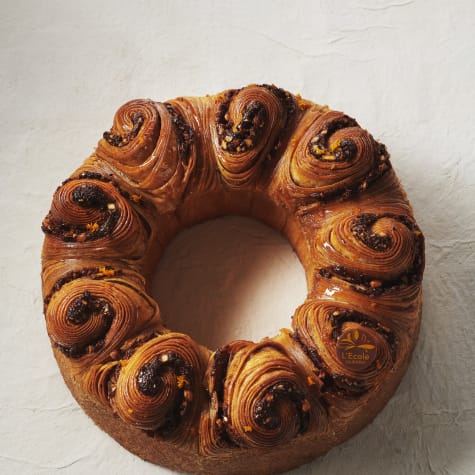
Narangi
Made with milk chocolate Bahibe 46%
An original recipe by Arthur Gavelle
2 stepsMakes eight 20cm-diameter tarts
Recipe Step by Step
Step01
PUFF PASTRY FOR CROISSANTS
1500 g Strong flour
30g Salt
225g European-style butter
210g Sugar
75g Egg
608g Mineral water
60g Live yeast
750g European-style butter (for the pastry)
3458g Total weight
Basic mixing temperature: 115/120°F (46/50°C).
Place all the ingredients except the butter in the bowl of a mixer.
Knead for 6 minutes at low speed. Add the yeast and knead for another 5 minutes at the
second lowest speed.
Take the dough out of the bowl, roll it into a ball and let it rise for 30 minutes at a standard
pastry-making room temperature (75°F or 24°C).
Shape the dough into rectangles, then store them for at least 12 hours in the refrigerator at
34°F (1°C).
Knock back the dough, then wrap it around the dry butter.
Make a book fold then a single fold, before leaving it to rest in the refrigerator for at least an hour.
Place all the ingredients except the butter in the bowl of a mixer.
Knead for 6 minutes at low speed. Add the yeast and knead for another 5 minutes at the
second lowest speed.
Take the dough out of the bowl, roll it into a ball and let it rise for 30 minutes at a standard
pastry-making room temperature (75°F or 24°C).
Shape the dough into rectangles, then store them for at least 12 hours in the refrigerator at
34°F (1°C).
Knock back the dough, then wrap it around the dry butter.
Make a book fold then a single fold, before leaving it to rest in the refrigerator for at least an hour.
Step02
HAZELNUT & ORANGE FILLING
250 g Bahibe 46%
125g European-style butter
100g Toasted hazelnut paste
210g Hazelnut flour
210g Toasted chopped hazelnuts
15g Cornstarch
115g Egg whites
3g Fleur de sel
155g Confectioner’s sugar
15g Orange zest
1198g Total weight
Melt the Bahibe couverture and butter.
Incorporate the rest of the ingredients.
Store at room temperature.
Incorporate the rest of the ingredients.
Store at room temperature.
Assembly and finishing
As needed European-style butter
As needed OABIKA
As needed Orange zest
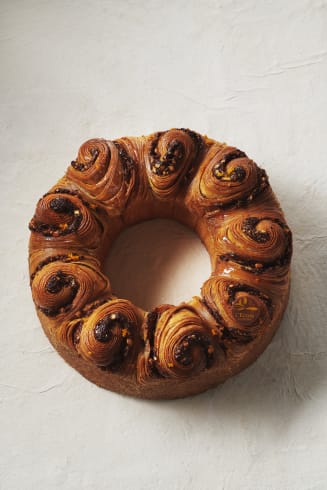
Use some creamed butter to grease the inside of a 20cm ring (depth: 6cm) and the outside of an 8cm ring (depth: 6cm).
Place the 8cm ring in the middle of the 20cm ring, and put both on a perforated baking sheet covered with a perforated silicone mat.
Cut the dough into quarters so each piece is 18cm wide.
Knock the dough back to a depth of 3mm to form a 80 × 20cm rectangle.
Spread on 300g of hazelnut and orange filling, but keep 2cm clear along the dough’s length so you can make the join.
Slightly wet the part that isn’t covered with filling.
Roll it up width-wise.
Refrigerate for 1 hour, then cut it into 4cm wide pieces using a cutter.
Evenly space out the 9 pieces between the 20cm and 8cm rings.
Leave to rise for 2 hours at 82°F (28°C)
Make sure there is some moisture in the proofing box.
Bake for 25/30 minutes at 340°F (170°C).
Immediately turn out the ring, then brush it with Oabika syrup.
Once it has cooled, grate on some orange zest.
Meet the Chef

Pastry Chef Instructor at Tain l’Hermitage
Arthur Gavelle
In my view, Easter is a time of year for families to get together, share and, most importantly, treat themselves to some delicious food. This brioche ticks every one of those boxes and even plays around with some other classic Easter tropes with its egg-shaped portions. For an extra-indulgent touch, you can replace the orange with spread or praliné at the end of the baking process. Work in as cold a setting as you can, ideally 32/34°F (0/1°C). If the temperature is higher, the yeast will activate and the dough will start rising. Make sure you stick to the rest periods so the dough rises well, and don’t leave it at too high a temperature (ideally it should be 81/84°F or 27/29°C)
Learn more